
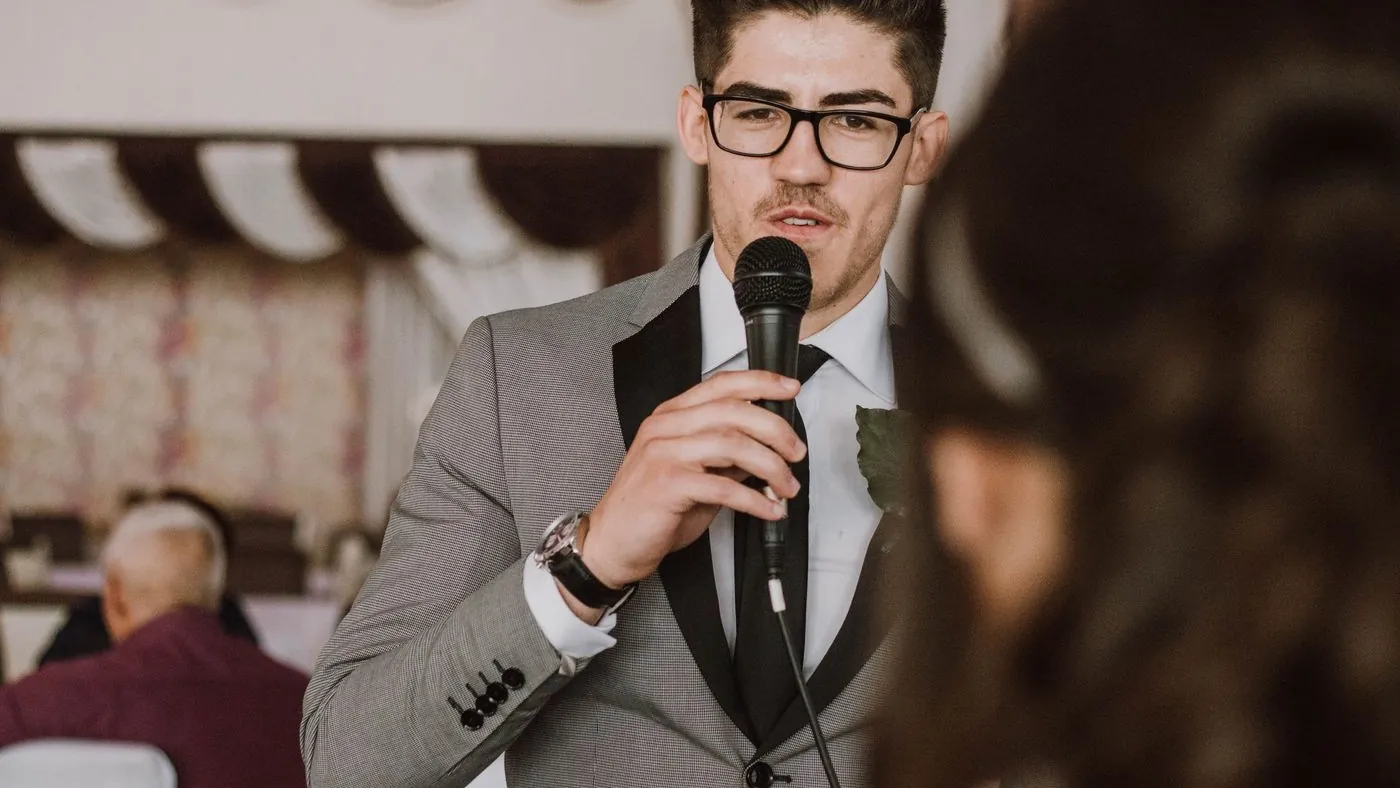
A good wedding speech is short (three to five minutes), personal, and kind. Introduce yourself, tell one or two real stories that show who the couple are, say something sincere, and finish by raising a glass. Then rehearse it out loud enough times that you can look up from your notes.
How long should it be?
Three to five minutes is a good target, and shorter is rarely a problem. There will usually be several speeches, the guests have been sitting a while, and nobody has ever complained that a toast was too short. Ask the couple or the MC how long you have, and how many others are speaking.
A simple structure
- 1Who you are. One line. "For those who don't know me, I'm Sam, and I've been Alex's best friend since grade four." Half the room may not know you.
- 2A story about one of them. Something real that shows who they are: kind, funny, stubborn, loyal. Gentle teasing is fine. Embarrassment is not.
- 3How they are together. The moment you knew, what changed when they met, what they bring out in each other.
- 4Something sincere. A wish, a hope, a line about what you admire. This is the part people remember.
- 5The toast. Ask everyone to stand and raise a glass, then say it simply: "To Alex and Jordan."
What to leave out
- Exes, past relationships and anything about the stag or bachelorette weekend.
- Inside jokes that only three people will understand. If you must, explain it in a line.
- Anything you would not say in front of their grandparents.
- Jokes at the expense of the marriage, the family or the cost of the wedding.
- A list of thank-yous, unless it is your role to give them. That usually falls to the couple or their parents.
- Jokes copied from the internet. Guests have heard them.
Adding humour
A wedding speech does not need to be a comedy routine, but a laugh early on relaxes you and the room. The best humour comes from a true story told well, not a one-liner. Earl's own example: asked to make a toast at a good friend's wedding, he bought a new toaster, put bread in it, and partway through speaking said, "Just a second, I have to make my official toast." He brought the toaster up, flipped the bread out, got a big laugh, and then went into his speech. Read more in his tips on adding humour to a speech.
Rehearse it out loud
Most wedding speeches go wrong because they were written but never practised. Reading it in your head is not rehearsal. Stand up and say it out loud, several times, over a week or two before the wedding.
- Time it. If it runs over five minutes, cut.
- Memorize your first line and your toast, so you start and finish looking at the room.
- Turn the rest into short cue cards with a few words for each part, not a full script on your phone.
- Practise once in front of someone who will be honest, ideally someone who knows the couple.
- If there will be a microphone, practise holding something in your non-dominant hand, about six inches from your mouth. That is Earl's tip: use your dominant hand for the mic and you will end up shaking it when you gesture.
On the day
- Go easy on the drinks before you speak. Alcohol dries out your throat and loosens your judgement about what is funny. Keep water nearby.
- Breathe before you begin. One slow breath from the diaphragm, then your first line. See our breathing exercises.
- Slow down. Nerves speed you up. Pause for laughs, and pause before the sincere part.
- If you get emotional, stop and breathe. Take a sip of water. Guests will wait, and a moment of real emotion is one of the best things that can happen in a wedding speech.
- Look at the couple during the sincere part, and at the room for the stories.
Want help with it?
Delivering the perfect wedding speech is one of the things Earl coaches. A session or two of one-to-one coaching, in person in the Toronto area or online, is often enough to tighten the draft and practise the delivery. If speaking in front of people makes you very nervous, our guide to getting over the fear of public speaking is a good place to start.